What Is a Campaign Wiki? (And Why Every DM Needs One)
Your players just asked what that blacksmith's name was. The one from three sessions ago. The one who gave them the quest that started this entire arc.
You know you wrote it down somewhere. You open three tabs, scroll through a shared Google Doc, and eventually find a half-sentence buried in your session 7 notes: "Blacksmith - Gorren? Gorrik?" You guessed at the spelling. You cannot remember which one you said out loud.
This is what happens when your campaign lives in six different places. Important details fall through the cracks. Continuity breaks. Your world starts to feel inconsistent. Not because you did not care. Because you had no system.
A campaign wiki fixes this. It is probably the most underused organizational tool in tabletop gaming, and I think the reason is simple: nobody ever explains what one actually is.
Let's fix that.
What is a campaign wiki?
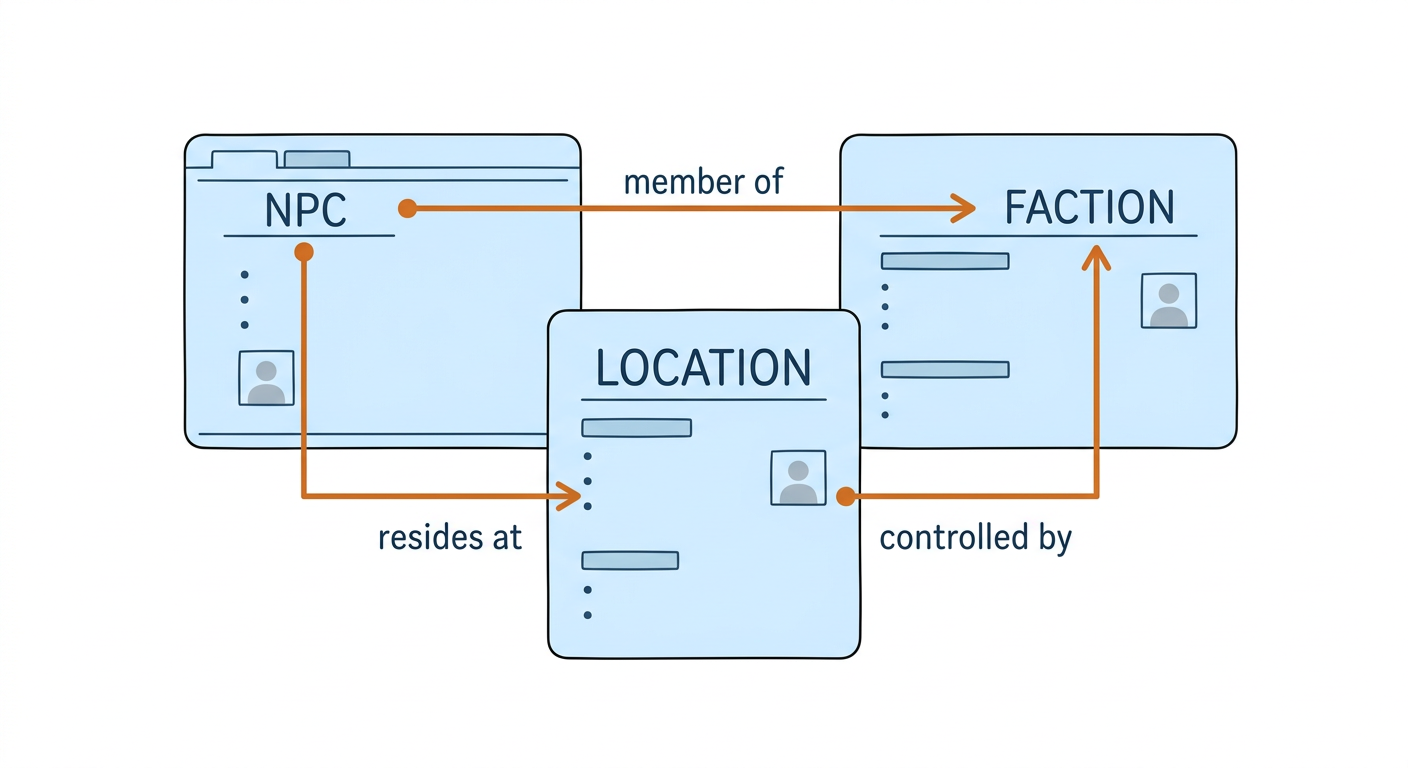
A campaign wiki is a structured, searchable reference for your tabletop RPG campaign. Instead of keeping session notes in a long, chronological document, a wiki organizes your world by entity. Every NPC, location, faction, item, and piece of lore gets its own page. Those pages link to each other, creating a web of connections that mirrors the relationships in your story.
Think of it like Wikipedia, but for your campaign. Lord Harwick has a page. That page links to the Merchant's Guild (his faction), Thornfield Keep (his stronghold), and the six sessions where he appeared. If a player asks "What do we know about Lord Harwick?", the answer is one search away.
That is a different animal from session notes. Session notes are chronological: what happened, in order, session by session. A wiki is relational. It records what exists in your world and how everything connects. Session notes tell you what happened in session 12. A wiki tells you everything about Lord Harwick, including what happened to him in session 12. A campaign journal sits between them and keeps the active quests, mysteries, and consequences you need for the next game.
A D&D campaign manager is the broader workflow around that wiki. It should carry session events into current state, entity histories, open threads, and a safe player view after every game.
Campaign wikis can be simple or elaborate. Some DMs build them by hand in tools like Notion or Google Docs. Others use dedicated worldbuilding platforms. And some tools build the wiki automatically from your sessions, so you never have to update it manually.
The format matters less than the linking. What makes a wiki a wiki is that every page connects to related pages. When you read about a location, you can click through to the faction that controls it and the NPC who governs it. That network of cross-references is what turns scattered notes into something you can actually use at the table.
What goes in a campaign wiki?
You can put almost anything in a wiki, but most campaigns need the same core categories.
1. NPCs and characters
Every named character in your world deserves a page. Include their role, their relationships, their location, and what has happened to them across sessions. The most common continuity error in long campaigns is contradicting NPC details. If Lord Harwick was allied with the Crown in session 4 but you accidentally say he works for the rebels in session 15, your players will notice. A wiki page prevents that.
For the exact fields to keep on each page, copy the D&D NPC tracker sheet. If the problem is helping players recognize the cast, use the separate guide to curing NPC amnesia.
2. Locations
Cities, dungeons, taverns, planes of existence. Track who controls them, what has happened there, and what the party knows about them. Locations accumulate history fast. By session 20, that little fishing village might have been the site of two battles, a political assassination, and the party's first encounter with the main villain.
3. Factions and organizations
Who are the power players in your world? Track their goals, their members, their relationships to each other, and how the party has interacted with them. Faction politics create the most compelling long-term campaigns, but they are also the hardest to track without a dedicated reference.
4. Items and artifacts
Particularly important for magic items, quest items, and anything the party is carrying that has narrative significance. Where did it come from? What does it do? Who wants it?
5. Session history
A timeline of what has happened, linked to the entities involved. This is where session notes and the wiki overlap. The wiki page for Lord Harwick should show a timeline of every session he appeared in and what happened each time.
6. Lore and world rules
Homebrew rules, creation myths, how magic works in your setting, the political structure of the kingdom. This is the stuff that lives in the DM's head and slowly becomes inconsistent as the campaign stretches past session 20.
7. Unresolved plot threads
What is still hanging? Which promises did the party make? Which villain is still out there? This is the section that saves your prep time. Instead of re-reading six months of session notes before each game, you check the open threads and plan from there.
So what happens when a player references an NPC from ten sessions ago?
If you have a wiki, you pull up the page and answer in three seconds. If you don't, you either bluff, stall, or spend two minutes scrolling through old notes while the table waits.
That moment, multiplied across dozens of sessions, is why campaign wikis matter. But the benefits go deeper than quick lookups.
Your world stops contradicting itself.
Without a central reference, you will contradict your own lore. It is not a question of if, but when. The blacksmith's name changes between sessions. A faction's motivation shifts without explanation. An NPC who was supposed to be dead shows up again because you forgot you killed them off. Players notice these things, even when they don't say anything. A wiki keeps your world internally consistent, which makes it feel real.
Your prep time drops.
Most DMs spend 30 to 60 minutes before each session just remembering where things stand. Keeping track of your campaign should not require archaeology through your own notes. A wiki gives you the current state of your world in one place. Open it, check the active plot threads, start planning. As Sly Flourish points out, the best note systems are the ones simple enough that you actually use them.
New players can actually join your campaign.
Onboarding a new player into a campaign that has been running for six months is painful without documentation. You either give them a 30-minute oral history or hand them a 50-page Google Doc and hope they read it. A wiki lets them browse at their own pace. They can read about their character's faction, the city they're in, and the major NPCs they'll meet. No one has to play the "previously on" narrator.
Continuity stops being a heroic effort.
DMs who run great long campaigns are not superhuman note-takers. They just have better systems. When every entity in your world has a page that links to related pages, the art of campaign continuity stops being a memory test and becomes a side effect of how you organize.
I have run campaigns for years. The ones that felt the most real to my players were never the ones where I prepped the hardest. They were the ones where I could answer any question about the world without opening five tabs first.
Three ways to build a campaign wiki
The tool you pick determines how much upkeep you are signing up for. There are basically three approaches, and they trade off control against maintenance.
Manual wikis (Notion, Google Docs, Obsidian)
The most common approach. You create a document or database, add pages for each entity, and update everything by hand after every session.
Best for: DMs who enjoy organizing as a hobby. If building and maintaining the wiki feels like part of the fun, manual tools give you total control over structure and formatting. Notion's database features and Obsidian's bidirectional linking make them popular choices. For a deeper comparison, see our breakdown of Notion vs dedicated D&D tools.
The tradeoff: Manual wikis are only as current as your last update. If you skip a week of maintenance, the wiki falls behind. After a few skipped weeks, it becomes an archive instead of a reference. The r/rpg community has discussed this problem extensively, and the pattern is always the same: enthusiasm at the start, abandonment by month two.
Dedicated worldbuilding platforms
Tools like World Anvil and Kanka are built specifically for TTRPG worldbuilding. They offer templates for NPCs, locations, factions, and timelines out of the box. To see what every one of them charges and what you get at no cost, read World Anvil vs Kanka vs LegendKeeper.
Best for: DMs who build their world before they play. If you write hundreds of pages of lore, design political systems, and flesh out cultures before session 1, these platforms give you purpose-built tools for that kind of deep worldbuilding.
If you are weighing one of these up against a play-first approach, we broke the trade-off down properly in World Anvil alternatives for D&D, including where World Anvil is genuinely the better pick.
The tradeoff: They are designed for building worlds from scratch, not for capturing what happens during play. If your campaign is heavily improvised or player-driven, you still need to manually log session events after every game.
Auto-updating wikis
A newer approach. The wiki updates itself based on what happens at the table. You play your session, and the tool turns the recording into structured wiki entries.
Saga20's world builder works this way. After each session, every NPC, location, and faction page gets updated with what happened. Lord Harwick's page shows a timeline of every session he appeared in, what he did, and how his relationships changed. You did not write any of that.
You give up some control over how entries are phrased. But for most DMs, a wiki that exists and stays current beats a perfect wiki that is three sessions behind.
Quick comparison:
| Manual (Notion, Docs) | Dedicated Platform | Auto-Updating Wiki | |
|---|---|---|---|
| Setup time | Low | Medium | Low |
| Maintenance per session | 30-60 min | 30-60 min | Minutes |
| Cross-linking | Manual | Built-in templates | Automatic |
| Searchability | Depends on tool | Strong | Strong |
| Stays current | If you keep up | If you keep up | Yes |
| Best for | Organizing hobbyists | Lore-first builders | Play-first DMs |
Can you start a campaign wiki mid-campaign?
Yes. You should. The idea that you need to start from session 1 is the single biggest reason DMs never start at all.
Here is the thing: starting mid-campaign is actually easier. At session zero, you are guessing about what will matter. Twenty sessions in, you know. You know which NPCs are active, which locations keep coming back, which plot threads are still open.
1. Pick your tool (or let your sessions build it for you)
You can use Notion, Google Docs, Obsidian, a dedicated worldbuilding platform, or an auto-updating tool like Saga20. The best tool is the one you will actually maintain. The D&D Beyond community has great threads on what works for different table sizes and play styles.
2. Start with what matters right now
Do not backfill 20 sessions of history. Create pages for your active NPCs, your current locations, and your open plot threads. That is your starting wiki. It covers maybe 15 to 20 entities. You can build it in an hour.
3. Add past content only when it becomes relevant again
When a player mentions an NPC from session 3, create that page then. When the party returns to a city they visited months ago, add it then. Let relevance drive your backfilling, not completeness.
4. Link everything
The value of a wiki is in the connections, not the pages. Every time you mention an NPC on a location page, link to their page. Every time a faction appears in a session summary, link to the faction. These cross-references are what make a wiki useful instead of just a collection of isolated documents.
If the maintenance overhead is what stops you, consider tools that handle the linking and updating for you. The world builder in Saga20 creates entity pages and cross-links them from your session recordings, so the wiki grows on its own.
What separates a good campaign wiki from an abandoned one?
Most DMs who start a wiki abandon it within two months. I have done it myself. The ones that survive tend to share a few traits.
You can search it. If finding an NPC takes more than ten seconds, the wiki is not doing its job. Full-text search is the minimum. Tags and categories help, but at the table mid-session, you are going to type a name into a search bar and expect an answer.
The pages link to each other. A pile of isolated pages is not a wiki. It is a filing cabinet. The useful part is when Lord Harwick's page takes you to his faction, his stronghold, and every session where he showed up. Without cross-links, you are maintaining a more complicated notes document for no real benefit.
It is actually current. A wiki that is six sessions behind is an archive, not a tool. It cannot help you prep because it does not reflect your world anymore. This is where most wikis die. If updating takes 45 minutes after every session, you will stop doing it. If it takes five minutes (or happens on its own), you probably will not.
Your players can see it. The best wikis are shared. When players browse between sessions, they show up knowing more, caring more, and referencing things that happened months ago. A wiki locked behind the DM's laptop is a prep aid. A shared wiki is a campaign artifact.
If your wiki is hard to search, painful to update, or invisible to your players, it will not survive. Aim for sustainable, not perfect.
Start yours this week
A campaign wiki is not extra work on top of running the game. It replaces the work you are already doing badly: re-reading old notes, guessing at NPC names, forgetting which faction betrayed which.
Whether you build yours in a Google Doc or let it build itself from your sessions, the payoff shows up fast. Prep takes less time. Your world holds together. Players start referencing things from months ago like they happened yesterday.
That is what a good wiki does. It makes your world feel like it remembers itself.
Questions
Common questions
Free Tools
Helpful for This Topic
Drop the notebook
Try Saga20 for free
Record your session. We'll write the notes and build your wiki.
Get started freeNo card needed