Notion vs a Tool Built for D&D
Notion is a flexible workspace that you can shape into almost anything. Saga20 is a campaign tool that records your sessions, writes the notes, and keeps your world wiki current without any manual updates. Both work for D&D. They just solve different problems.
Free to start. No credit card required.

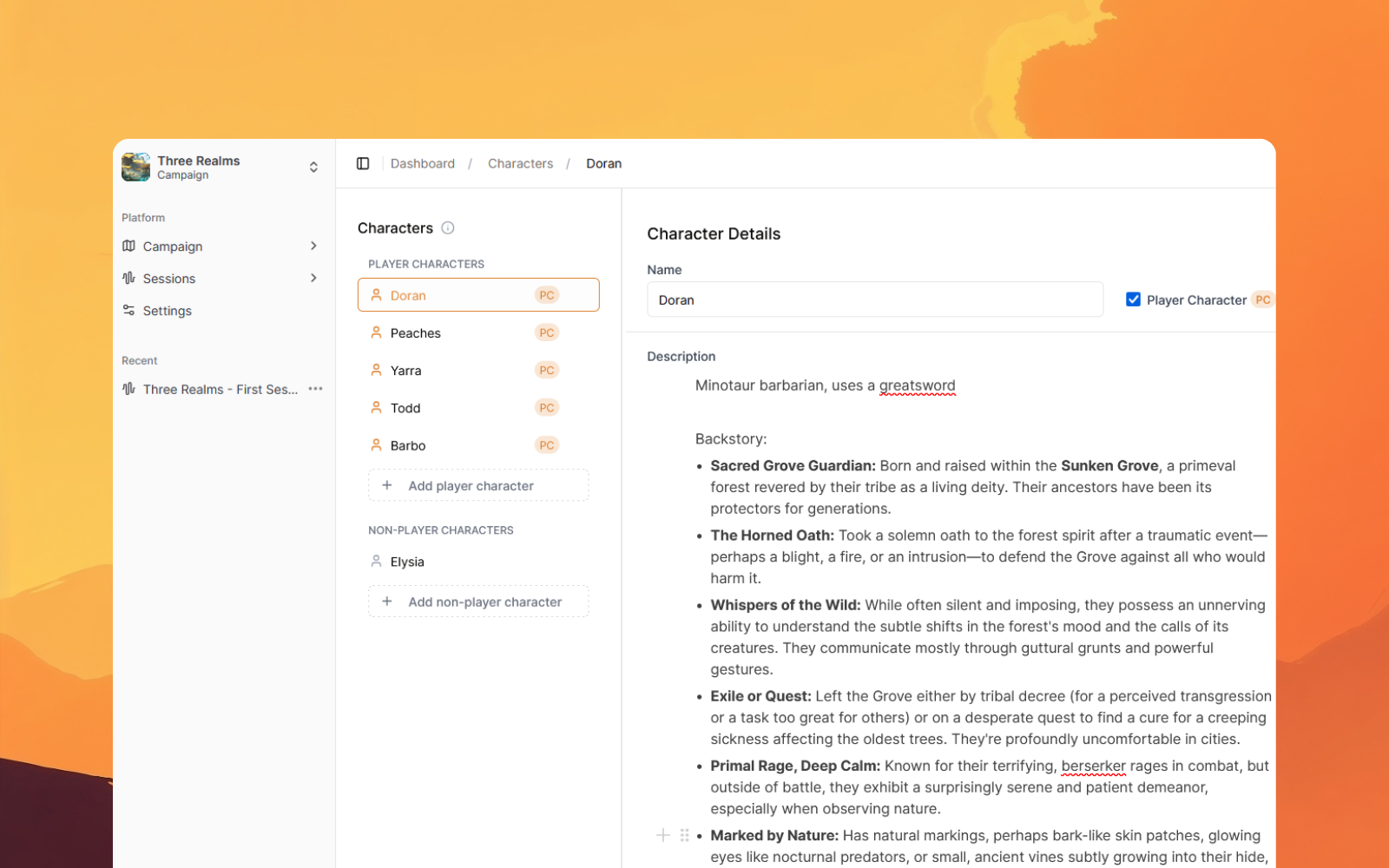
Thousands of Dungeon Masters track their campaigns in Notion. It works. You build databases for NPCs, create linked pages for locations, and maintain session logs by hand. The question is whether that time investment makes sense when tools exist that do the tracking for you. Below is an honest look at what Notion does well for D&D, where it gets painful, and how Saga20 takes a different approach.
Which one fits the way you run games?
Neither tool is objectively better. It depends on what you value most at the table.
Notion is best for you if...
- You enjoy building organizational systems from scratch
- You want total control over the layout and structure of your notes
- You already use Notion for work or school and want everything in one place
- You prefer to build your world before the campaign starts
- You need a native mobile app today for editing on the go
Saga20 is best for you if...
- You run sessions and forget to update your notes afterward
- You're already a few sessions behind on your campaign wiki
- You want session notes and your wiki to update on their own
- You want your players to have a living reference they can browse
- You started mid-campaign and need to catch up without rewriting everything
Feature comparison: Saga20 vs Notion for D&D
Notion is a general purpose workspace. Saga20 is built specifically for tabletop RPG campaigns. Here is what each one does and doesn't do.
| Feature | Saga20 | Notion |
|---|---|---|
| Session recording | ||
| Automatic session summaries | ||
| Auto-updating wiki | ||
| Voice recognition (who said what) | ||
| Character and NPC pages | ||
| Location tracking | ||
| Campaign relationship graph | ||
| Custom templates | ||
| General productivity tool | ||
| Mobile app | Coming soon | |
| Free tier | ||
| Setup time | Minutes | 2-4 hours |
| Time per session to stay current | 0 min | 30-60 min |
Based on publicly available feature information as of April 2026.
Where your time actually goes
Over a 20-session campaign, Notion maintenance adds up to 10-20 hours of work outside the game. Here is what the workflow looks like side by side.
After every session with Notion
Write session notes from memory
Update NPC and location databases
Link new entities to existing pages
Reorganize and tag entries
Share updates with players
After every session with Saga20
Upload your session recording
Session summary is generated
Wiki pages update with new events
That is the difference between 20 hours of admin work and 20 minutes over an entire campaign.
Try Saga20 FreeHow DMs use Notion for D&D today
Sly Flourish (Mike Shea) has a solid walkthrough of using Notion as a Lazy DM. Worth watching if you want to get the most out of a Notion-based setup.
Video by Sly Flourish. If you want a deep Notion-based workflow, start here.
Questions DMs actually ask
What about my existing Notion template?
If you've already invested hours into a Notion setup, switching feels like throwing that work away. Fair enough. The real question is whether maintaining that system for the rest of your campaign is worth the ongoing time. In most D&D subreddit threads about this, you see the same pattern: the template works great for the first few sessions, then slowly falls behind as the campaign grows and sessions pile up. The longer it runs, the harder it gets to keep everything linked and current.
Saga20 doesn't require you to abandon anything. Some DMs use Notion for session prep and homebrew rules while letting Saga20 handle the post-session tracking and world building.
Is it worth paying for when Notion is free?
Notion's free tier is generous, and that matters. But the cost of a campaign tool isn't just the subscription price. It's the time you spend maintaining it. If you spend 45 minutes after every session updating Notion, that's 15 hours over a 20-session campaign. Whether your post-game time is worth more than a few dollars a month is up to you. Saga20 has a free tier too, so you can compare them without spending anything.
Can I use both?
Yes. Notion is great for things Saga20 doesn't do: session prep templates, homebrew rule documents, encounter planning, general project management. Think of it this way: Notion is your workbench before the game. Saga20 is your historian after it. If you want to go deeper on keeping track of your D&D campaign, we wrote a full guide on the different approaches.
Common questions
Your campaign wiki should not be a second job
Record your session. Saga20 writes the notes, updates the wiki, and maps the relationships. You get back to playing.
Keep reading
World Builder
See how Saga20 builds and maintains your campaign wiki automatically after every session.
Session Summarizer
Upload a recording and get structured session notes with characters, locations, and key events.
Real Campaign Examples
Browse actual session summaries and wiki pages from real D&D campaigns running on Saga20.