D&D Downtime Activities 5e: What to Do Between Adventures (2026)
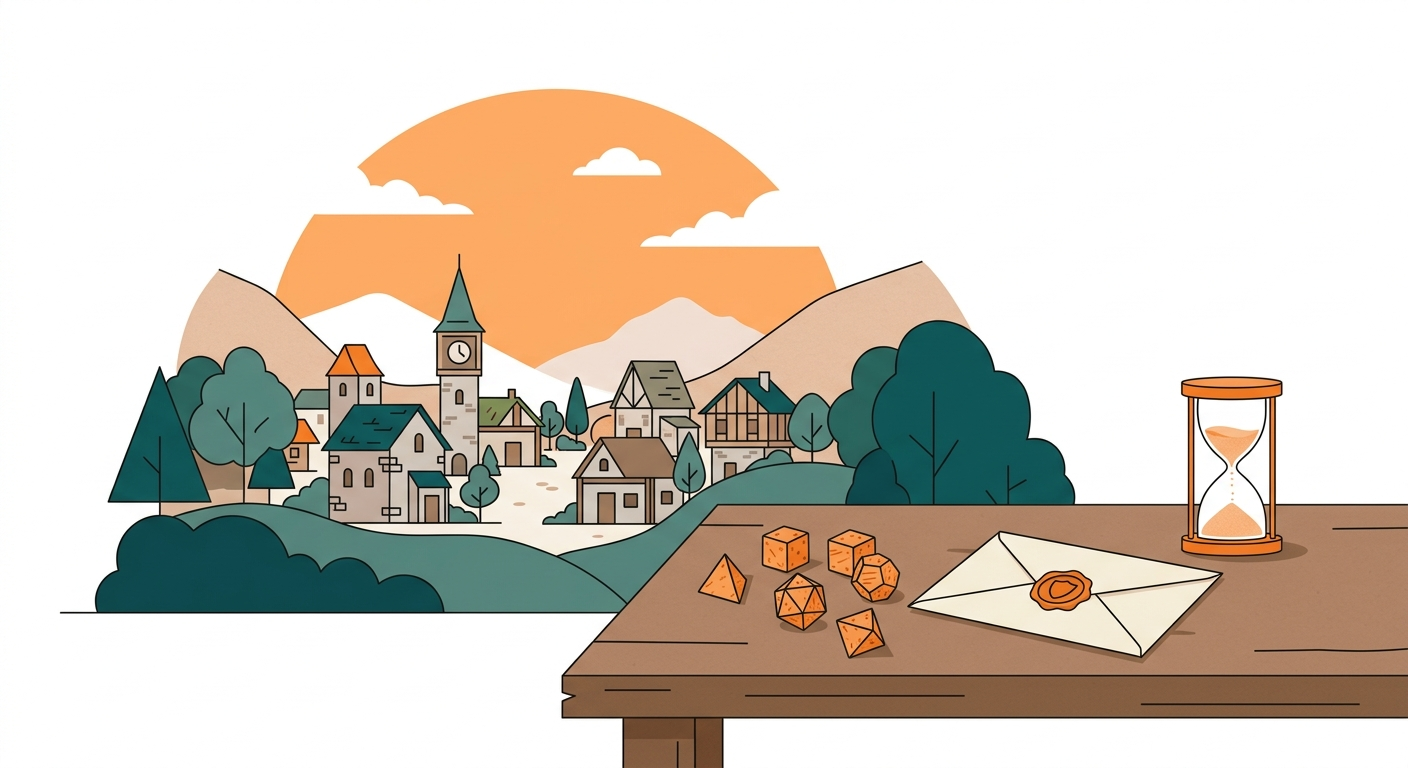
Downtime is what happens when the dungeon is over and the next crisis has not kicked in yet. That sounds like dead air, but it is one of the most useful parts of a D&D campaign. It turns gold, favors, injuries, friendships, guilt, and ambition into things the table can actually play with later.
The problem is that downtime activities in 5e are easy to overbuild. One player wants a business. One wants a dead-god mystery. One wants the next fight. Without a shape, downtime becomes homework for some players and waiting time for the rest.
Here is the shape that works: one time block, one goal per character, one cost or risk, one consequence worth writing down.
What counts as downtime in 5e?
Downtime is any meaningful stretch of campaign time when characters are not in an active adventure scene. The party is back in town, traveling safely, waiting for a festival, recovering after a hard fight, or spending a month before the duke's council meets.
The 2014 D&D Basic Rules section on between-adventures activity gives the useful baseline: characters can craft mundane objects, practice a profession, recuperate, research, and train. They are the spine.
If your table owns Xanathar's Guide to Everything, it adds a wider menu. If you play Adventurers League, the old consolidated downtime activities document is still useful as a reference for limited downtime resources. You do not need to copy either approach exactly. You just need the same discipline: define the activity, the time, the cost, and the result.
For a home campaign, I would phrase downtime this way:
Downtime is a choice the character makes between adventures that should either spend a resource, reveal information, build a relationship, change the world, or create a future complication.
If an activity does none of those things, let it happen in one sentence and move on.
The 10-minute downtime loop
You can run downtime as a full session, but most groups need the lighter version. Use this loop when you want the pause to matter without swallowing the night.
- Name the time block. "You have ten days in Greyharbor before the trial." That is much easier to act on than "What do you do now?"
- Ask for one goal each. Not a schedule. A goal. "I want to find out who funded the ambush." "I want to recover from the mummy's curse." "I want to earn the temple's trust."
- Pick a cost or risk. Gold, time, a favor owed, a tool proficiency, a contact, a check, or a chance of trouble.
- Resolve in quick turns. Give each player a result in two or three sentences. Let one roll matter. Do not run a solo adventure unless the table asked for that session.
- Write down the consequence. The clue, rival, debt, contact, scar, promise, or rumor goes in your campaign notes.
That last step is the whole point. If downtime never comes back, players learn it is decorative. If the blacksmith they helped in downtime later hides them from city guards, the table learns that quiet choices count.
This is also where a campaign wiki earns its keep. Downtime creates small facts: who owes whom, which faction noticed the party, what injury still aches, which NPC got a second scene. Put those facts somewhere searchable before the next session starts.
Downtime activities you can offer tonight
You do not need a giant menu. Offer a dozen broad choices and let players skin them around their characters.
| Activity | Time block | Good for | Result to bring back later |
|---|---|---|---|
| Research a clue | 1 to 10 days | Wizards, clerics, lore-heavy characters | A true fact, a false lead, or a named expert |
| Train with a mentor | 1 week to 1 month | Any character with a personal goal | A teacher, a rival student, or a small technique |
| Recover from harm | 3 days or more | Injured, cursed, poisoned, or shaken characters | A healed condition or a lingering mark |
| Work a profession | 1 week or more | Grounded characters with normal lives | Wages, gossip, and local reputation |
| Build a contact | 1 to 10 days | Rogues, bards, nobles, faction members | A favor, a price, and a reason the contact calls later |
| Serve a faction | 1 week | Paladins, clerics, soldiers, guild members | Standing, orders, or a conflict of loyalty |
| Maintain a home base | 1 week to 1 month | Parties with a tavern, ship, keep, or workshop | Staff trouble, local support, or new obligations |
| Craft mundane gear | Days to weeks | Artisans, survivalists, practical players | Useful equipment and a supplier relationship |
| Investigate a rumor | 1 to 5 days | Curious players and urban campaigns | A lead, a witness, or a warning |
| Make amends | 1 scene to 1 week | Characters with guilt or social fallout | Forgiveness, refusal, or a new promise |
The secret is that every activity should create a handle: a person, pressure, promise, rumor, or problem you can pick up later. "I earn 12 gp" is useful. "I earn 12 gp working for the baker whose son joined the river cult" is campaign fuel.
How much time should downtime take?
Start with the campaign clock, not the activity list.
If the villain attacks tomorrow, the party does not have a month to study pottery. They might have one evening to make a contact, buy supplies, pray, or search a library. If the next adventure begins after winter thaw, let bigger projects breathe.
These time blocks work well:
| Time available | Best use |
|---|---|
| One night | A conversation, a message, a small purchase, a quick lead |
| Three days | Recuperation, simple research, local gossip, short faction work |
| One tenday | Training scenes, contacts, crafting simple gear, reputation work |
| One month | A serious personal project, business upkeep, travel prep, major research |
| One season | Base building, long training, political shifts, community change |
Do not be afraid to say no gently. "That is a month-long project, and you have three days" is not shutting the player down. Offer a smaller version: "You cannot finish the training, but you can find the mentor and earn one lesson before you leave."
For pacing, I like a five-minute table pass. Each player gets the same question: "What do you want out of this break?" Then I resolve the simple actions, spotlight the risky ones, and end by reading the new campaign state aloud. Ten minutes later, we are at the next adventure with a richer world behind us.
What should require a roll?
Roll when uncertainty will make the story better.
Researching a common festival date does not need a roll. Researching which noble secretly paid the assassin probably does. Recovering from a normal bruise does not need a roll. Shaking off a supernatural sickness might.
Use three outcomes:
| Result | What happens |
|---|---|
| Success | The character gets what they wanted, or enough of it to matter |
| Success with cost | They get it, but spend extra gold, owe a favor, attract attention, or lose time |
| Complication | They still learn something useful, but a new problem enters the campaign |
The third line matters. Do not make a failed downtime roll mean "nothing happens." If the bard fails to win over the magistrate, maybe the magistrate refuses the favor but accidentally reveals who already has their ear.
For more table-friendly thinking, this Reddit guide to downtime options treats downtime as character expression, not just errands. Veritas Tabletop also has a practical piece on what to do during downtime as part of campaign rhythm.
How do you keep downtime from becoming homework?
The trap is asking players to send you long private plans between sessions. That sounds efficient, but it often gives the loudest planner the most story, hands the DM unpaid admin, and leaves the rest of the table outside the consequences.
Keep downtime public unless secrecy is essential.
Ask players for their goals at the table and resolve most of them there. If someone writes a longer note afterward, fine, but the campaign result should still be short enough to share in the next recap.
I use this format:
- Goal: What the character wants.
- Method: How they try to get it.
- Cost: Time, gold, risk, favor, or check.
- Result: What changes.
- Hook: Why this might matter later.
That last line turns a private errand into shared campaign fuel. If you already use a session recap, add a small "Downtime changes" section so players see the results before the next game. If your table tends to spend too long in town, a session time manager can help you decide how much of the night belongs to downtime.
A quick example
The party has ten days before the duke's masquerade.
The cleric wants to research the symbol found under the ruined chapel. You ask for an Intelligence (Religion) check and 10 gp in donations to temple archives. On a success, they learn it belongs to a banned funerary order. Hook: the temple archivist asks the cleric to find three missing pages.
The fighter wants to train with the old captain outside town. No roll. The captain agrees after the fighter helps repair the flooded practice yard. Hook: the captain recognizes the villain's dueling stance later.
The rogue wants a contact inside the masquerade staff. That needs Charisma (Persuasion) or Dexterity (Stealth), depending on the method. Success gets a servant contact. A complication means the contact is real, but also terrified of the duke's spymaster. Hook: the spymaster now has a description of the rogue.
That is three downtime choices, three future handles, and no separate side session.
The video version
If you want another DM's framing before you run it, Dungeon Dudes has a clear video on using downtime without losing the campaign thread:
Use videos like this for philosophy, then keep your own table procedure small. The more complicated the system becomes, the less often you will reach for it.
What should you write down?
Write less than you think.
After downtime, capture only the facts that can matter later:
- Who the character met
- What changed in a relationship
- What clue or rumor surfaced
- What resource was spent
- What favor, debt, or obligation now exists
- What future scene this points toward
That is it. You do not need a full transcript of the wizard's research week. You need the archivist, the missing page, and the symbol under the chapel.
This is the same habit that keeps long campaigns healthy. Prep light, play the session, then preserve the consequences. If you want the broader campaign loop, read how to run a D&D campaign after this. If you want the fast version for next week, use the 30-minute D&D session prep method and add one downtime consequence to your prep notes.
The simplest rule
Downtime is not the space between the important scenes. It is where the next important scene gets seeded.
Give every player one meaningful choice. Make time and cost clear. Resolve it quickly. Write down one consequence. Bring that consequence back later, even in a small way.
Do that, and the weeks between adventures stop feeling like skipped time. They become the part of the campaign where characters build lives worth interrupting.
Questions
Common questions
Free Tools
Helpful for This Topic
Session Time Manager
Keep downtime from eating the whole night. Plan how much table time each between-adventures scene gets before play starts.
Session Recap Generator
When downtime changes a faction, contact, or obligation, capture it in a recap your players can read before the next adventure.
Session Recap Architect
Build a repeatable note template for downtime choices, consequences, and loose threads.
Drop the notebook
Try Saga20 for free
Record your session. We'll write the notes and build your wiki.
Get started freeNo card needed